Accidents and Failures With Complex Multidimensional Scientific Issues
Quick Reads - Actionable Information for Litigators, Insurers, Corporate Counsel, and Corporate Leaders..
APPROACH
John Fildes, Ph.D.

Key takeaways....
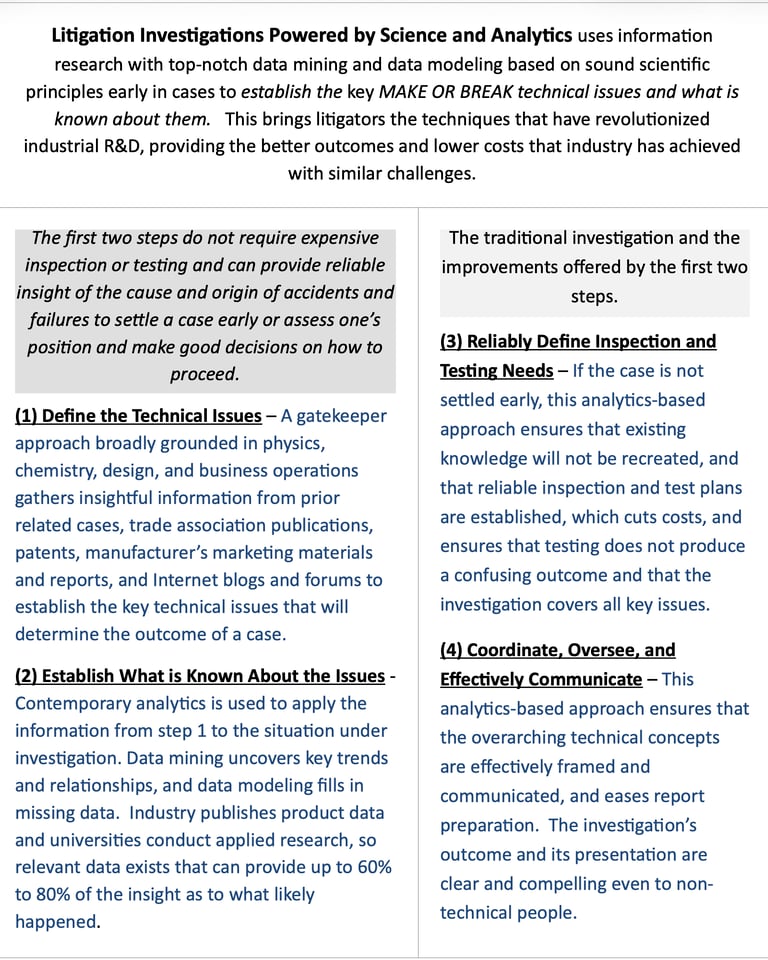
Multidisciplinary issues create complexity that requires a broader approach than the typical expert investigation. A superior approach is described in this Quick Read and summarized in this table.
Introduction
The increasing use of engineered materials such as plastics and composites in aircraft, automobiles, structures, building materials for floors and facades, spray foam insulation, and consumer products introduces multidisciplinary issues into technical investigations to establish the cause and origin of accidents and failures. Multidisciplinary issues are also encountered in chemical processes such as used in water treatment, industrial processes such as extrusion and injection molding, pharmaceutical and chemical manufacturing, and materials fabrication.
A highly advantageous aspect of advanced materials is that their fabrication and installation can be merged into a single step, but this moves the factory to a home or job-site and places a highly technical chemical process in the hands of untrained workers. Investigating an accident or failure in these situations requires simultaneous investigation of the design of the structure or part, the design of the material, and the chemistry of the materials fabrication process.
This type of investigation is different from an investigation based on the inspect, test, report paradigm. Take the seemingly simple roadway chip sealing process used to resurface all types of roadways. Binder is sprayed onto the roadway, gravel aggregate is spread, and a roller then pushes the aggregate into the binder. What could be more simple? Nonetheless, this deceptively simple process resulted in the relatively quick failure of tens of miles of roadway that resulted in a very visible and costly situation.
A typical narrowly focused engineering investigation conducted by an expert from a major research university concluded that the aggregate violated codes and caused the failure, but I was able to show that the cause of the failure was in reality due to choice of a newer type of binder that was an organic material that is not tolerant of even slightly wet aggregate as compared to a water based emulsion as is typically used. Organic binders are used in asphalt production plants where the aggregate is dried in specialized equipment under the control of trained technical staff and operators. In contrast, the chip seal process moves the asphalt plant to the uncontrolled weather of the roadway and places the demands of understanding the requirements to achieve chemical adhesion between the binder and the aggregate in the hands of people not trained in adhesion chemistry, or in asphalt manufacture.
Multiple Experts or a Different Type of Investigation Methodology?
An obvious approach to investigating multidisciplinary issues is to employ multiple experts, one covering each domain of knowledge and experience needed. This approach allows the use of experts you already know and may have used in the past, but this approach also has important limitations, the most limiting of which Is that someone has to handle the interface between the different disciplines.
Another limitation is that someone would have to coordinate the work of the individual experts to ensure that the investigation covers all aspects of the accident or failure, but experts are expected to work independently and not have the scope of their work. channeled by someone else.
The multiple experts would likely have to rely on data and analyses developed by each other, which poses substantial challenges to the independence of each expert’s investigation and to coordinating the timing of each expert’s investigation. Using multiple narrow experts makes an attorney a technical project manager, which is a demanding role for which they may have no training.
Multiple experts testifying in narrow domains may also cause confusion and appear to be contradicting each other even if they are not. A major problem is that no-one testifies to the entirety of the investigation so the overall context is not clearly conveyed in depositions or at trial.
Importantly, but not readily apparent, is that the use of multiple experts precludes or severely limits the use of analytics to discover trends and insight in data that contains uncertainty and that is contaminated by unrelated factors and in datasets that are so large that it is hard to find trends and insight
The Importance of Physical Chemistry For a Different Investigation Methodology
Litigation technical investigations powered by physical chemistry & analytics differs in meaningful ways.
Physical chemistry is uniquely relevant to investigating many types of failures and accidents because the scope of physical chemistry provides much of the scientific basis for many of the common engineering disciplines. Using the organization of Atkins’s 4th. Edition Physical Chemistry Text to define the top level hierarchy of physical chemistry, physical chemistry can be divided into thermodynamics (called “Equilibrium” in Atkins’s text), quantum mechanics (called “Structure” in Atkins’ text), and kinetics and electrochemistry (called “Change” in Atkins’ text).
Thermodynamics underlies much of chemical compatibility and reactivity, chemical processes and control, and changes of state (gases, solids, liquids), to name a few encountered in chemical engineering. Quantum mechanics underlies much of the strength of materials encountered in mechanical engineering, and underlies the numerous spectroscopies frequently encountered in engineering and scientific investigations. Kinetics underlies much of the rates of chemical reactions such as combustion, liquid and gas flow, and diffusion encountered in chemical engineering. Electrochemistry provides the scientific basis and measurement methods for corrosion as encountered in metallurgy.
The Importance of Analytics for a Different Investigation Methodology
The data that is available from an accident or failure is often limited in what is measured and in how often it is measured, and the data will likely be influenced by factors that are not completely related to the cause of the failure or accident.
An important attribute of physical chemistry is that it is a quantitative science. Mathematically quantifying the properties of materials of all kinds and predicting the properties of these materials under the fully range of prevailing conditions is central to physical chemistry, and analytics is a natural companion to physical chemistry for quantifying and predicting properties in a scientifically sound manner, one that is grounded in the reality of the situation under investigation.
An expert with the broad knowledge that physical chemistry provides can apply the sophisticated data mining techniques offered by analytics to uncover trends in the available data even when that data is sparse as is often the case, and to identify which portions of the data are similar and which portions are different. These techniques help identify changes in the state of a complex system and define the bounds over which the relevant models will have to provide reliable predictions.
An expert with the broad knowledge of physical chemistry can also augment the sparse data that is available in a situation under investigation with data derived from models built on the scientific principles that underlie the accident or failure. Thermodynamics might be used to reliably estimate chemical stability and reactivity; electrochemistry might be used to reliably estimate corrosion susceptibility; chemical kinetics might be used to reliably estimate evaporation rates, corrosion rates, or the rate of developing adhesion; chemical bonding might be used to reliably estimate the strength of materials, their susceptibility to aging and attack by the environment, and their strength under loading and impact.
The scientific method is inherent in this approach since an intrinsic aspect of this approach is to use the models to predict the available data. This validates the models that were used and tests hypotheses of the cause and origin of an accident or failure. Another highly valuable outcome of this approach is that the validated models shed uniquely deep insight as to the nature of the scientific processes that are reflected in the data from the incident under investigation.
The cause and origin of accidents and failure involving multidisciplinary issues usually cut across the underlying disciplines and thus require a multidisciplinary perspective. Technical investigations of multidisciplinary issues by experts with broad knowledge and experience will produce results that are much easier to understand because the results will be related to the full spectrum of issues involved in the accident or failure and can be understood in the context of the accident or failure. Understanding narrow, isolated aspects of an accident or failure can be far more difficult as well as hard to explain to non-technical people because the context of the accident or failure is lost.
Bio for John Fildes, Ph.D.
Dr. Fildes is a doctoral scientist who has conceived, organized, and conducted $28 million of projects including R&D, litigation expert investigations, and collaborations involving Government labs, large defense companies, and leading universities.
Dr. Fildes was also CEO of an $18 million professional scientific/engineering consulting firm; president of a not-for-profit R&D institute; founder and leader of a $6 million scientific/engineering consulting firm; leader of a $3.5 million startup product design firm; leader of a $10 million contract research lab at Northwestern University; a senior professional in the $4.5 billion Borg-Warner Corporation Research Center.
Product Failures Expertise
Friction; Abrasive Wear, Adhesive Wear, Testing, Friction Measurement, Wear Prevention, Lubricants, Oil Quality Monitoring, Solid Lubricants, Hard Protective Coatings, Decorative Coatings, Paint, Electroplated Coatings, Corrosion, Electrochemical Corrosion Measurement, Ice Prevention; Gas Sensors, Carbon Monoxide Detectors; Product Design Procedures.
Materials & Process Expertise
Composites for Aviation, Buildings and Civil Construction: Thermoset and Thermoplastic Resins and Adhesives, Resin Transfer Molding, Autoclaving, Impedance Spectroscopy; Use of Composite Materials and Spray Foams Made On-Site In Construction; Roadway Chip Sealing, Water Treatment; Intelligent Process Control.
Chemistry & Chem Processes Expertise
Prediction Of Materials Properties, Stability, And Compatibility; Chemical Exposure; Chemical Process Equipment Failures.
Contact us
Whether you have a request, a query, or want to work with us, use the form below to get in touch with our team.