Analytics Based On Physical Chemistry Really Works in Litigation-Related Scientific Investigations
Blog - Actionable Information for Litigators, Insurers, Corporate Counsel, and Corporate Leaders.
BLOG POST
John Fildes, Ph.D.

Key takeaways....
This blog post shows the diversity of cases in which Dr. Fildes' analytics based on physical chemistry approach works. This post also explains why this approach works and what its numerous benefits are.
Introduction
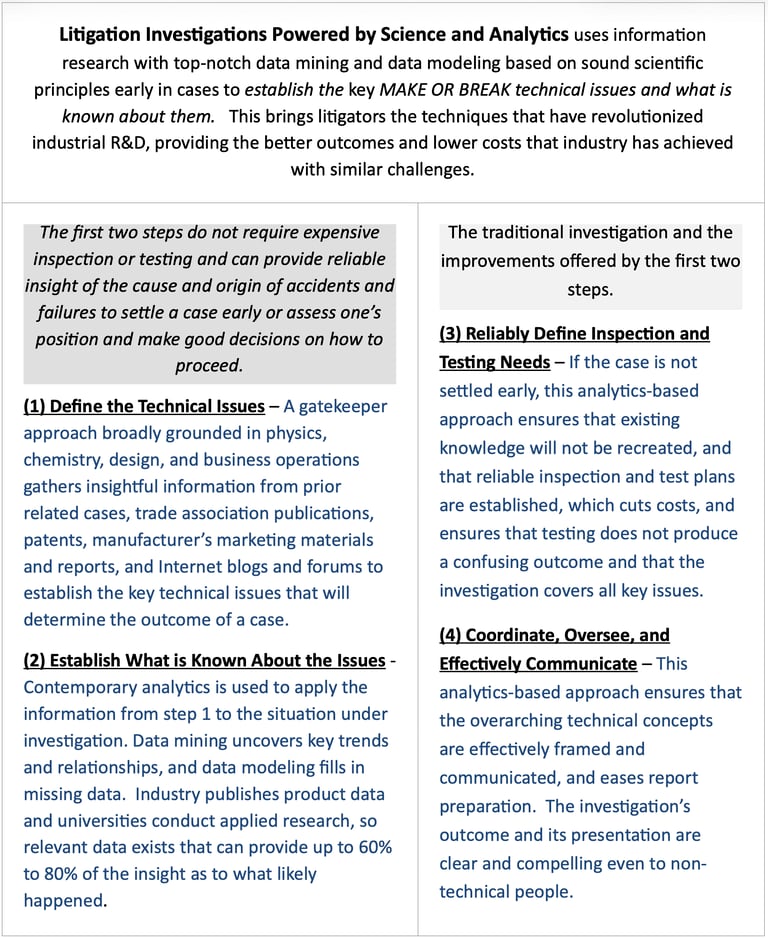
Dr. Fildes’ bases his litigation-related scientific investigations on an approach that uses analytics based on physical chemistry. This approach, more fully described in PChem Analytics in Technical Investigations and summarized in the table below, uses analytics from the outset of the investigation to fuse fundamental physical chemistry principles, which underlie many engineering disciplines, with data that is available from the incident under investigation and relevant publicly available industrial and academic studies to establish, early in the investigation, 60% to 80% of what can be known about what could have happened and what could not have happened. This approach is fundamentally different from the conventional inspect, test, report approach and it really works and provides important benefits. This blog post looks at why it works and what benefits it provides.
Analytics Based On Physical Chemistry Works In A Diverse Array of Cases and Issues
Dr. Fildes has used the analytics based on physical chemistry approach in his doctoral research, throughout his R&D career, and in his litigation-related investigations spanning straightforward accidents through investigations involving complex multidisciplinary issues with tens of millions of dollars of loss potential. The following sample shows the diversity of the issues for which this approach enabled Dr. Fildes to provide authoritative, compelling insight that numerous other experts missed. More detail can be found on many of these in the Case Studies section of www.jfildes.com.
Dr. Fildes has used this approach in dispute-related investigations to correct misinterpretation of chemical test results by other experts. He did this by using analytics to fuse well established physical chemistry principles with the chemical test data obtained by the other experts to provide context for the chemical tests that was missing but that was essential for proper interpretation of the test results.
Chemical tests are readily accessible to experts because results are based on computer database matching, but this does not always produce the correct chemical identification. Misinterpretation of the results is a real possibility without knowing the chemical context to interpret the meaning of the test results for the specific situation under investigation. Dr. Fildes has seen non-chemical experts such as mechanical engineers blindly rely on the computer database matching results even thought these results were wrong and did not even make sense. Dr. Fildes’ analytics based on physical chemistry approach made the correct interpretation, which did make sense and showed the true cause of the incidents under investigation.
Dr. Fildes has also used analytics based on physical chemistry principles to clarify ambiguous metallurgical test results. For example, Dr. Fildes used a thermodynamic energy balance of an industrial cooling system to remove the ambiguity of corrosion test results produced by other experts. Also in several corrosion investigations, Dr. Fildes used the physical chemistry subdomain of electrochemistry to authoritatively establish the cause of corrosion which is difficult to do by conventional means. Other experts misdiagnosed or produced ambiguous results in each of these investigations. Dr. Fildes also used the analytics based on physical chemistry approach to authoritatively establish key properties of an asbestos containing product that has not been produced since the 1970’s ,which allowed the resolution of many cases involving this product. This approach is uniquely effectively when materials no longer exist for inspection or testing.
In a case involving very complex multidisciplinary issues, Dr. Fildes extensively used analytics to authoritatively establish the thermal behavior of a complex piece of industrial heating equipment based on very sparse data from the incident. He used data modeling to estimate the composition of gas feeding the equipment’s burners and how it varied during the incident under investigation and his estimates closely matched the record temperature data. This case required submission of expert reports before fact witness depositions and Dr. Fildes’ analytics based on physical chemistry approach allowed him to used well established combustion physical chemistry, chemical kinetics, thermodynamics, and vapor physical chemistry to predict many aspects of the incident. Every prediction was consistent with the extensive amount of information produced by fact witness depositions taken after Dr. Fildes’ predictions were made.
A case involving the products of a water treatment process also presented complex multidisciplinary issues. Dr. Fildes used the analytics based on physical chemistry approach to predict the chemical composition of the water treatment products which depend on the continuously varying chemistry of the water being treated as well as the seasons of the year. These predictions closely matched the chemical composition measurements that existed in this case. Dr. Fildes treated the concentrations of the approximately 10 chemical species in each chemical composition as the elements of a vector. This allowed Dr. Fildes to treat the chemical composition variation of the water treatment products as fingerprints and to use mathematical similarity analysis such as cluster analysis to establish which samples were related. Dr. Fildes was also able to use this approach to show that the sample collection by another expert had also captured contamination as was seen in photos of the sample collection and therefore produced erroneous results.
A case that went to trial (resulting in a full verdict for the defendant whose attorney hired Dr.. Fildes) involved a road resurfacing technique. The new surface had been installed in the summer on tens of miles of roadway and had failed with the onset of cold weather that same year. Hundreds of cars were damage by loose aggregate in addition to the roadway having to be resurfaced again, resulting in a damage claim of millions of dollars. A senior professor from a major research university was used near the time of the failure by the installer of the new surface to investigate the cause of the failure.
This case demonstrates that accidents and failures happen because scientific principles are violated. The plaintiff’s expert opinion was that the aggregate supplied did not meet the State’s codes and this caused the failure of the new roadway surface. Dr. Fildes showed that a careful reading of the codes and of the several tests that had been conducted of the aggregates size distribution did not clearly support this opinion. Since codes and standards are often established by consensus and in the case of civil and building codes have to represent the nature of materials that are locally available, Dr. Fildes used data mining of many states’ codes and standards to establish the range of aggregate size distribution that would result in a durable road surface from the road resurfacing technique involved in this case. He identified relevant data and analyzed almost 80 aggregate size distribution specifications from more than two dozen states and several major research studies. This analysis clearly established that the aggregate size distribution in this case fell in about the middle of the range that is used across the numerous states examined to produce a durable roadway surface.
In this case, Dr. Fildes identified several model-based design tools developed by the Federal Government and that are utilized by several states to guide their use of this road resurfacing technique. Dr. Fildes applied each of these models and combined their results to establish the range of aggregate size distributions that would provide a durable roadway surface using the road resurfacing technique that was investigated in this case. The results of this data modeling not only further validated the data mining results described above, but also provided scientific insight as to what factors of an aggregate’s size distribution are important to obtain a durable roadway surface. These factors further confirmed that the aggregate used in this case would be expected to provide a durable roadway surface, which was more easily understood by the jury.
Data mining and data modeling by Dr. Fildes in this case also uncovered important insight about what other factors could cause a roadway that was resurfaced with this technique to fail within a few months as the temperature dropped. The model-based resurfacing design techniques coupled with fundamental chemical principles and patent literature on the binder used established a failure mechanism due to lack of adhesion between the binder and aggregate because of excessive moisture. This failure mechanism was validated by showing how it matched observations made during the resurfacing and the manner in which the surface failed.
Why The Analytics Based On Physical Chemistry Approach Works
There are many reasons why the analytics based on physical chemistry approach works. An important one is that it embodies the scientific method, which is the way science is practiced in the mainstream of scientific endeavors and therefore is the manner of practice that meets the rules of evidence used by the courts.
Another reason is that the analytics based on physical chemistry approach establishes the key issues early in an investigation so the work is properly focused. Tests that will produce unambiguous results can be identified, and the results of testing can be compared to predictions so as to identify and resolve testing abnormalities. Also, relevant insight that already exists from well-done industrial studies and academic research is used rather than recreated. All of these benefits improve the outcome of the investigation while cutting costs.
Another reason the analytics based on physical chemistry approach works is that the underlying cause of a vast array of accidents and failures is related to violation of the scientific principles underlying various materials and the analytics based on physical chemistry approach is uniquely powerful for analyzing and modeling the properties of materials. These types of issues are multidisciplinary and the analytics based on physical chemistry approach provides a wholistic approach to investigating them, avoiding the use of multiple experts who may produce disjointed results.
Another reasons is that litigation situations most often have sparse data because industrial processes and consumer products are not instrumented in the way that lab tests are. Litigation investigations also tend to occur far (often years) after the incident which limits the utility of inspections and testing that can be performed. Analytics based on physical chemistry overcomes these challenges by fusing well established scientific principles with relevant data from reliable industrial and academic sources, which often exist in investigations, to establish what could have happened and what could not have happened to cause an accident or failure. This insight may not specifically establish the cause, but it provides a reliable and powerful way to place bounds on what could have and what could not have caused the accident or failure and this is often enough to exclude all but one conclusion given the know facts in a case.
Another reason the approach is so effective is that non-technical people may not fully understand the details of complex scientific concepts, but they do comprehend the confidence that is imparted by the same conclusion being reached by different analyses. Analytics based on physical chemistry principles often allows two or more semi-independent ways to reach a conclusion and non-technical people understand the confidence this builds in the validity of the conclusions even if they do not understand the scientific details. This also makes the conclusions more specific, and it makes deposition and trial testimony straightforward and easier to understand.
Analytics helps make abstract concepts real by changing the focus from the concept to how the situation is similar to other situations where no failure occurs. Without use of analytics, this similarity may not have been uncovered and would have made the testimony more about having to explain the complex scientific concepts in abstract terms.
The value of using analytics in litigation investigations, especially ones that are more complex and multidisciplinary, cannot be overstated. A message from the Dean of Virginia Tech’s College of Science stated “At the Virginia Tech College of Science, we have reimagined scientific research…. We are focused not on data itself, but amplifying the relevance of that data with analysis, modeling, and interpretation.” (Va. Tech Science, Fall 2019). Testing the hypotheses made in an investigation is inherent in this approach, which is extremely valuable since testing hypotheses is an essential aspect of the scientific method that guides the normal conduct of scientific investigations and that is also fundamental in litigation-related technical investigations to meet the rules of evidence.
Bio for John Fildes, Ph.D.
Dr. Fildes is a doctoral scientist who has conceived, organized, and conducted $28 million of projects including R&D, litigation expert investigations, and collaborations involving Government labs, large defense companies, and leading universities.
Dr. Fildes was also CEO of an $18 million professional scientific/engineering consulting firm; president of a not-for-profit R&D institute; founder and leader of a $6 million scientific/engineering consulting firm; leader of a $3.5 million startup product design firm; leader of a $10 million contract research lab at Northwestern University; a senior professional in the $4.5 billion Borg-Warner Corporation Research Center.
Product Failures Expertise
Friction; Abrasive Wear, Adhesive Wear, Testing, Friction Measurement, Wear Prevention, Lubricants, Oil Quality Monitoring, Solid Lubricants, Hard Protective Coatings, Decorative Coatings, Paint, Electroplated Coatings, Corrosion, Electrochemical Corrosion Measurement, Ice Prevention; Gas Sensors, Carbon Monoxide Detectors; Product Design Procedures.
Materials & Process Expertise
Composites for Aviation, Buildings and Civil Construction: Thermoset and Thermoplastic Resins and Adhesives, Resin Transfer Molding, Autoclaving, Impedance Spectroscopy; Use of Composite Materials and Spray Foams Made On-Site In Construction; Roadway Chip Sealing, Water Treatment; Intelligent Process Control.
Chemistry & Chem Processes Expertise
Prediction Of Materials Properties, Stability, And Compatibility; Chemical Exposure; Chemical Process Equipment Failures.
Contact us
Whether you have a request, a query, or want to work with us, use the form below to get in touch with our team.