Dr. Fildes' Analytics Based on Physical Chemical Approach Helps Resolve Cases Early
Quick Reads - Actionable Information for Litigators, Insurers, Corporate Counsel, and Corporate Leaders..
APPROACHCASE STUDIES
John Fildes, Ph.D.

Key takeaways....
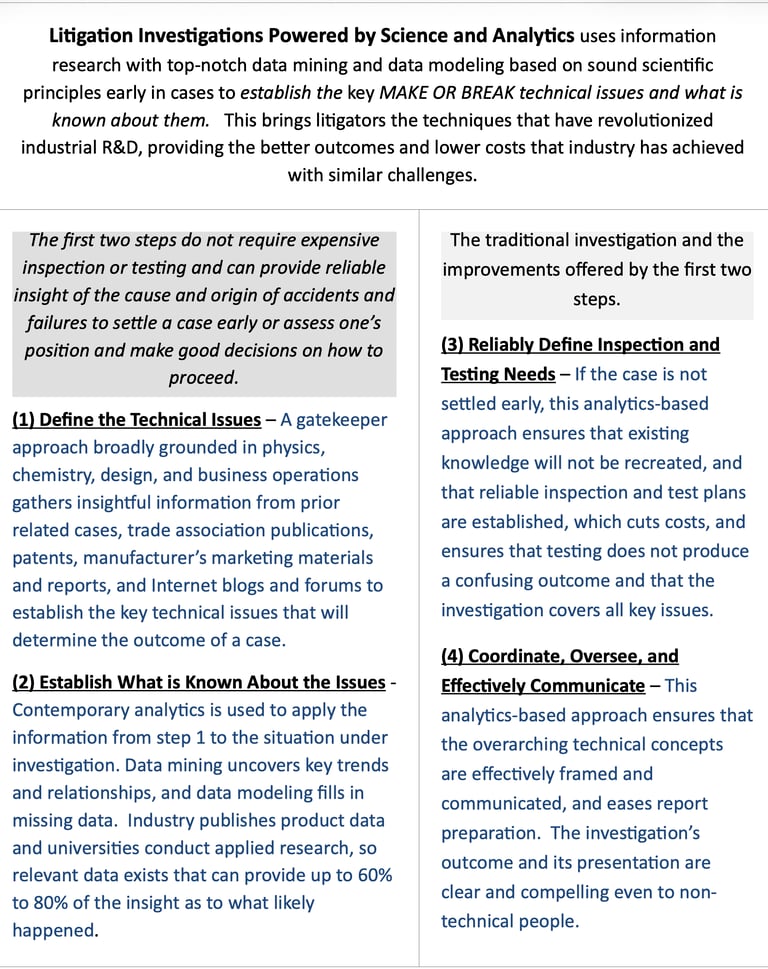
Dr. Fildes' analytics based on physical chemistry approach is highly valuable for helping to establish a dispute early without expensive, time consuming testing. This case study describes situations where Dr. Fildes has used the first two steps of the approach shown in the following figure to accomplish this.
Introduction
A primary desire in litigation, insurance claims resolution, and intellectual property disputes is to cut costs while improving outcomes. Resolving the case early is the proven way to achieve this goal. Investigations related to insurance claims and litigation, be they they to resolve a case early or as part of the normal discovery process, are about asking questions that illuminate the key issues and answering them clearly in a way that is authoritative and compelling.
Dr. Fildes has been involved in a number of investigations that were primarily intended to resolve a dispute early without fully going through discovery, and the only difference in this case is that costly and time consuming testing is not practical or effective. Many experts have difficulty dealing with this challenge, but Dr. Fildes’ analytics based on physical chemistry approach is a natural fit. This approach, as summarized in the table above, identifies and adapts existing data to establish what could have happened and what could not have happened to cause a failure or accident. This does not usually identify the exact cause of an accident or failure but it often can limit the possibilities to a degree that is compelling to resolve a case early.
Dr. Fildes has been a gatekeeper in corporate R&D and has been used for establishing the state of the art by Government Agencies. This unique experience is highly valuable for litigators and insurers because scientific gatekeeping and identifying the scientific state of the art are central to accurately identifying the key technical issues early in a litigation or insurance dispute.
It is common for there to be uncertainty and substantial gaps in the available data, especially early in the discovery process. To address this, Dr. Fildes uses focused, comprehensive research coupled with top-notch analysis to fill the information gaps that will exist in the relevant available information to develop a deep understanding of the key technical issues. Manufacturers publish studies and universities conduct applied research. Relevant research likely exists and can provide 60% to 80% of the insight that may ultimately be gained. Conducting a search of this nature and the analysis are skills that are central to industrial R&D, but not to product liability and accident investigations.
An outcome of this approach is that it places companies in an excellent position to screen claims and to achieve early resolution because this approach has already established the key issues involved. Companies can use this insight to assess who is likely to prevail, and what it will take and cost to prevail to set a reasonable basis for settlement that is supportable, authoritative, and compelling to the claimant.
Materials Will Often Be A Key Issue, Maybe the Key Issue
It is common for there to be issues involving the appropriateness of the selection of a material, material compatibility, the conditions to which the material was subjected, the adequacy of the design, the adherence to codes and standards, and the adequacy of installation methods and of maintenance frequency and procedures. Failures are often thought of as metallurgical or mechanical engineering issues, but the performance of materials is a substantial (often dominate) contributor in many types of failures. The increasing use of engineered materials such as plastics and composites in aircraft, automobiles, structures, building floors and facades, spray foam insulation, and consumer products introduces multidisciplinary issues such as chemistry into technical investigations to establish the cause and origin of these accidents and failures.
It may not be enough to first reach out to an expert in a narrow technical domain. Accidents do not happen, and products do not fail because standards and codes are not met, rather they happen because the underlying scientific principles are violated. In these cases, investigating design methods and standards and regulatory codes is not sufficient. Traditional experts such as metallurgical and mechanical engineers sometimes include chemical testing in their investigations, but Dr. Fildes has seen failures where uneducated use of chemical testing can lead to misdiagnosis of the cause and origin of a failure.
Chemistry is an Essential Discipline In Many Failures and Accidents and In Investigating Materials
For example, infrared spectra are a common chemical test that non-chemical experts can readily access through independent labs. Today, infrared spectra are often interpreted by computer matching to a database of spectra. Although this makes infrared spectroscopy accessible to non-chemical experts, it does not always provide the correct result. For example, Dr. Fildes assisted with identifying the correct spectral interpretation in a case where database matching had misinterpreted infrared spectra of motor antifreeze because its spectra has many similarities to brake fluid. This misinterpretation had led a mechanical engineer to misdiagnose the cause and origin of the failure.
Dr. Fildes also assisted in resolving a case involving propane gas. Part of his work in this case was to correct the misinterpretation of the gas infrared spectrum. Dr. Fildes is able to properly interpret chemical spectra because he understands both the physical chemistry principles the underlie the various chemical spectroscopies and he understands the chemistry of the substance being analyzed. It takes this combined experience, which many traditional non-chemical experts lack, to reliably specify and interpret chemical testing.
Investigations of metal corrosion is another area that benefits from chemical experience that metallurgists and mechanical engineers sometimes lack, Corrosion happens due to electrochemical interaction of the metal and environment so electrochemistry provides the underlying science to understand corrosion issues. Corrosion often involves painted metals which requires an understanding of both the sophisticated electrochemistry of painted metals and of adhesion chemistry. Dr. Fildes has this chemical and electrochemical experience and the specialized instrumentation needed, and insurers have used him to investigate aircraft corrosion incidents, sometimes involving tens of millions of dollars of loss exposure.
A highly advantageous aspect of advanced materials is that their fabrication and installation can be merged into a single step, but this moves the factory to a home or job-site and places a highly technical chemical process in the hands of untrained workers. For example, curing composite materials in the field involves running a staged multistep chemical reaction that requires strict adherence to a specific temperature profile. Installing spray foam insulation involves running a chemical reaction involving involving the accurate metering and mixing of chemicals that differ from the various suppliers of spray foam systems. The spray foam installer also has to carefully control the installation temperature and perform the installation within narrow boundaries for ambient temperature, humidity, and rate of spraying. Chip sealing of roads (i.e., rolling aggregate into hot binder) moves the asphalt production facility, which uses specialized equipment such as aggregate driers and controlled processing conditions operated by trained people, to the roadway where there is rudimentary equipment and little control of environmental conditions.
Another Example - Chemistry Is An Increasingly Important Contributor In Building Materials Failures
Building materials are increasingly high-tech products. Some of these products are wood based composites containing resins, or adhesives, and others such as composite exterior systems are products in which the chemical process for their formation occurs as part of their installation. The “engineered” aspect of advanced materials can make their use highly complex. For example, wood composite flooring has anisotropic (i.e. directionally dependent) expansion and shrinkage with changes in humidity.
Physical chemistry is central to investigating the performance and failures of advanced building materials. Physical chemistry principles are the basis for materials science, and thermodynamics, which is a branch of physical chemistry that provides the underpinnings of moisture transport in materials, and their expansion and contraction.
Moisture transport, and expansion and contraction are important properties of many building materials such as vapor barriers, insulation materials, and wood products of all sorts. The properties of these advanced building materials, especially their expansion and contraction with relative humidity changes, are often anisotropic. It is often impractical to measure the properties of these materials after they have been installed because they may have already been removed, or it may be difficult to alter the environmental conditions at will during testing over a wide range in a building, especially one that is in use. Fortunately, physical chemistry provides the tools to accurately estimate the important properties of these materials, even for complex layered materials. There is also a large body of data available to use in estimating the properties of these materials under various conditions. This data is generated by manufacturers to support sales, by academic research for student dissertations, and by trade studies to compare different technologies and products.
For building materials where the chemical formulation process is part of the installation, such as composite exterior systems, the chemicals from which these advanced building materials are made are often mixture of other chemicals that have been synthesized at an earlier stage, and the entire chain of reactions needs to be considered. It is also not uncommon to encounter proprietary formulations, and chemical analysis techniques are not always able to sufficiently unravel the complete nature of the proprietary formulation. Again, a good understanding of the underlying thermodynamics and physical chemistry enable this situation to be successfully addressed, and accurate estimates to be made. The chemical processing step of the installation process must also be considered, and this will depend on the installation procedures and equipment, and the prevailing temperature and humidity. Processing these types of resins may involve a sequence of reactions at higher temperatures that have to proceed by a tightly controlled trajectory over time to achieve changes in viscosity at the correct temperature so that adequate adhesion and chemical stability are achieved and so that chemicals that could leach out later over time are expelled prior to the material hardening.
Dr. Fildes has investigated many aspects of building and civil materials failures based in part on his work that was the basis for establishing Northwestern University’s federally funded Advanced Materials Processing Center. Part of Dr. Fildes work was on composites used in infrastructure. Dr. Fildes also won a highly competitive Defense Advanced Research Projects Agency project in this area, and he served as panelist on composites in the infrastructure at a SAMPE workshop. Dr. Fildes has also conducted litigation-related investigations of spray foam insulation odors and fires, and of expansion and contraction issues with engineered wood products.
Relative to engineered wood products, Dr. Fildes has used manufacturers’ literature and trade studies along with physical chemistry principles to accurately estimate the degree of expansion and contraction in different directions. This approach has allowed clients to investigate engineered wood products that have been removed and were not available, and to investigate site conditions during installation that could not be recreated later on. This approach also allowed clients to settle cases early through arbitration with having to incur the cost and time of extensive testing.
Dr. Fildes has also investigated cracking of laminated glass used in building windows. A commercial building experienced widespread cracking of its laminayted glass windows. Although the initial engineering investigation implicated water intrusion into the window frames, this was not the sole reason for the failure and not the underlying cause of the cracking. Dr. Fildes’ analytics/physical chemistry consulting approach used data from published military R&D studies to establish that the specified adhesive should not have contained a chemical that was know to cause cracking of the laminate, but this chemical was found in the laminate. Exposure of laminated windows containing this chemical are known to experience cracking.
Bio for John Fildes, Ph.D.
Dr. Fildes is a doctoral scientist who has conceived, organized, and conducted $28 million of projects including R&D, litigation expert investigations, and collaborations involving Government labs, large defense companies, and leading universities.
Dr. Fildes was also CEO of an $18 million professional scientific/engineering consulting firm; president of a not-for-profit R&D institute; founder and leader of a $6 million scientific/engineering consulting firm; leader of a $3.5 million startup product design firm; leader of a $10 million contract research lab at Northwestern University; a senior professional in the $4.5 billion Borg-Warner Corporation Research Center.
Product Failures Expertise
Friction; Abrasive Wear, Adhesive Wear, Testing, Friction Measurement, Wear Prevention, Lubricants, Oil Quality Monitoring, Solid Lubricants, Hard Protective Coatings, Decorative Coatings, Paint, Electroplated Coatings, Corrosion, Electrochemical Corrosion Measurement, Ice Prevention; Gas Sensors, Carbon Monoxide Detectors; Product Design Procedures.
Materials & Process Expertise
Composites for Aviation, Buildings and Civil Construction: Thermoset and Thermoplastic Resins and Adhesives, Resin Transfer Molding, Autoclaving, Impedance Spectroscopy; Use of Composite Materials and Spray Foams Made On-Site In Construction; Roadway Chip Sealing, Water Treatment; Intelligent Process Control.
Chemistry & Chem Processes Expertise
Prediction Of Materials Properties, Stability, And Compatibility; Chemical Exposure; Chemical Process Equipment Failures.
Contact us
Whether you have a request, a query, or want to work with us, use the form below to get in touch with our team.