Dr. Fildes' Composites Failure Investigations
Quick Reads - Actionable Information for Litigators, Insurers, Corporate Counsel, and Corporate Leaders..
CASE STUDIES
John Fildes, Ph.D.

Key takeaways....
Composites are fabricated from a variety of resin systems that have substantially different resin chemistry and cure kinetics.
Composite resin systems are often what are called thermosets in which the resin cures in an irreversible manner.
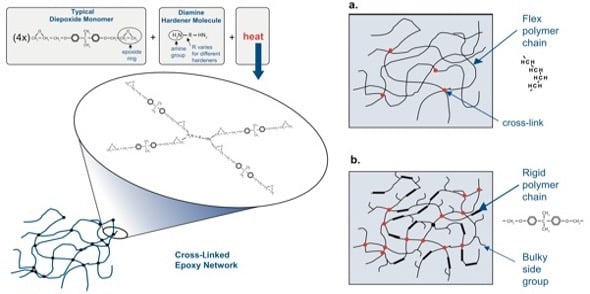
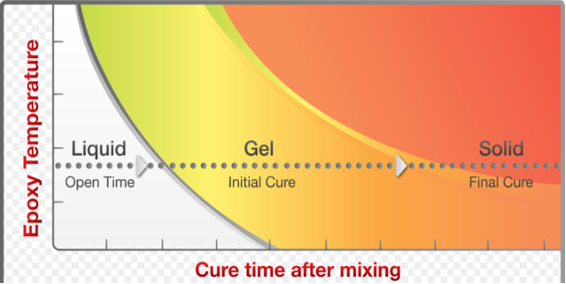
Thermoset resin systems typically cure by reactions that lengthen the molecular chains and reactions that crosslink the chains. Molecular chain lengthening increase’s the resin’s viscosity while crosslinking solidifies the resin. The relative rates of these reactions is critical to achieving the compaction and adhesion needed to bond the resin and fiber in the composite.
Cured resins age and the rate of aging depends on the amount of exposure to water (even water vapor) and higher temperatures, which also needs to be considered in a failure investigation.
Composite repair procedures involve heating the cured composite, so the degradation chemistry and chemical kinetics need to be considered in investigating composite failures.
Dr. Fildes has extensive experience with resin system chemistry, kinetics, aging and degradation, and thermal degradation. Dr. Fildes’ research at Northwestern University was the basis for establishing Northwestern’s federally-funded Advanced Composite Materials Intelligent Processing Center of which Dr. Fildes was the co-director. His composites research has also won funding in highly competitive competitions.
Introduction
Structural composites are made from fibers enmeshed in a cured resin matrix. The orientation of the fibers and chemical adhesion play fundamental roles in the performance of composites, which makes failure analysis a multidisciplinary activity involving chemical processing during a structure’s fabrication as well as the nature of the fractures in the failed structure.
Dr. Fildes has investigated a variety of failures involving composites including aircraft fuselages, wings, and blades, and composites used in construction and the infrastructure such as laminates, wood, and composite bridges and walkways. Dr. Fildes’ physical chemistry, materials science, and chemical engineering background is well suited for the multidisciplinary nature of these investigation involving chemistry, adhesion, mechanics, and chemical processes.
Dr. Fildes’ research at Northwestern University was the basis for establishing Northwestern’s federally-funded Advanced Composite Materials Intelligent Processing Center of which Dr. Fildes was the co-director. His composites research has also won funding in highly competitive competitions such as DARPA’s Technology Reinvestment Program. Dr. Fildes also organized and led multimillion-dollar composites R&D collaborations involving major aerospace composites, leading Government labs, the Army, the Navy, the Defense Advanced Research Projects Agency, and leading suppliers of composite products and technology.
Dr. Fildes’ composites research has addressed cure chemistry and processing of resins, aging and water degradation of composite resins, adhesion in composite sandwich structures, model-based control of resin transfer molding, resin flow monitoring, characterization of resins using impedance spectroscopy and infrared spectroscopy, and artificial intelligence model-based process control.
Composites Failure Analysis Is Multidisciplinary
The resins used in composites are multicomponent systems that cure through several competing reactions that cause the lengthening of molecular chains at the earlier stage of cure (a in the figure below) and crosslinking of molecular chains at the later stage of cure (b in the figure below). The length of molecular chains significantly influences the toughness (i.e. lack of brittleness) and the amount of crosslinking controls the strength and stiffness of a composite structure.
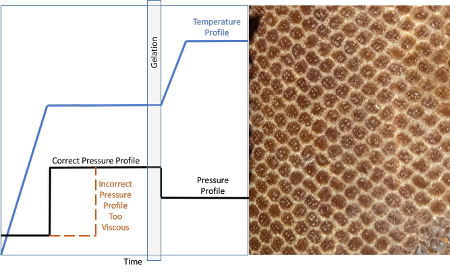
The relative rates of chain lengthening and crosslinking over time is controlled by chemicals called hardeners and possibly accelerators and by the temperature profile of the cure cycle. The viscosity of the resin first decreases and then increases over time as shown by the figure below. Pressure is applied when the viscosity is low to consolidate the composite and remove air bubbles.
Composites Processing and Fabrication
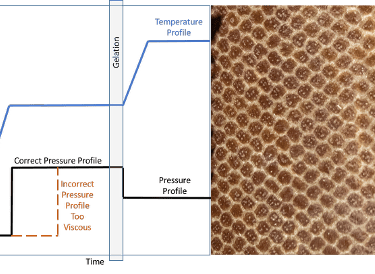
Dr. Fildes has investigated composite failures where the required pressure and temperature profiles were not followed during a structure’s fabrication. This can result in a structure not achieving the design strength, especially if the resin becomes too viscous before pressure is applied, which can result in inadequate compaction, stiffness, and strength. Bubbles in the cured resin suggest this type of failure mechanism.
Failure Analysis of Structures
Dr. Fildes has investigated failures of laminate composites and composite sandwich structures due to helicopter and aircraft accidents.
His investigations have been related to helicopter blades, wings, and fuselage structures and gliders, with suspected causes due to manufacturing defects, collisions, and degradation of adhesives due to thermally based repair processes.
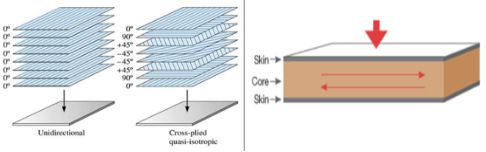
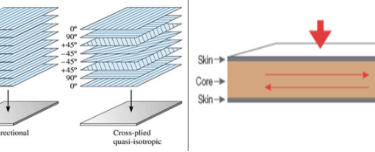
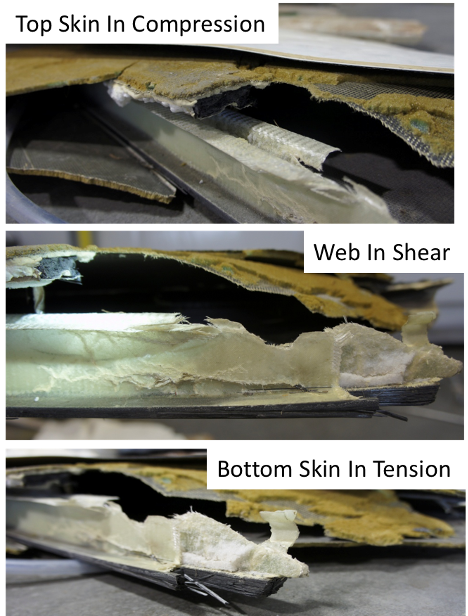
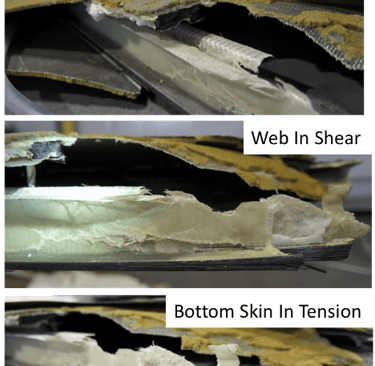
A common issue in failure analysis of composite structures involved in accidents is to determine if a failed structure was the origin of the accident or if the failed structure resulted from the accident. For example, the nature of the tears in a composite sandwich structure can reveal the origin of the failure. The figures below show a sandwich structure in which the top skin fractures have relatively smooth surfaces.
The bottom skin fractures have rough surfaces with fiber pullout and delamination in two planes due to the use of a unidirectional fiber architecture to minimize weight. The skin also shows tears that run 45 degrees to the chord, which indicates torsion of the structure. The web also shows a shear failure that is consistent with torsion.
Composite failures are almost always complex and multidisciplinary, often requiring review of fabrication logs and examining resin chemistry, chemical kinetics, and thermodynamics. Dr. Fildes’ has the experience to do this. For example, Dr. Fildes has investigated several cases involving determination of the cause of delamination of composite helicopter blades. Dr. Fildes found a manufacturing deviation in one failure that affects resin cure kinetics and viscosity during fabrication, and chemical adhesion. Another failure was alleged to be due to thermally induced damage to an adhesive from a repair procedure, which required an investigation involving thermodynamics and heat flow issues as well as instrumented laboratory simulations of a repair procedure coupled with FEA thermal modeling.
Bio for John Fildes, Ph.D.
Dr. Fildes is a doctoral scientist who has conceived, organized, and conducted $28 million of projects including R&D, litigation expert investigations, and collaborations involving Government labs, large defense companies, and leading universities.
Dr. Fildes was also CEO of an $18 million professional scientific/engineering consulting firm; president of a not-for-profit R&D institute; founder and leader of a $6 million scientific/engineering consulting firm; leader of a $3.5 million startup product design firm; leader of a $10 million contract research lab at Northwestern University; a senior professional in the $4.5 billion Borg-Warner Corporation Research Center.
Product Failures Expertise
Friction; Abrasive Wear, Adhesive Wear, Testing, Friction Measurement, Wear Prevention, Lubricants, Oil Quality Monitoring, Solid Lubricants, Hard Protective Coatings, Decorative Coatings, Paint, Electroplated Coatings, Corrosion, Electrochemical Corrosion Measurement, Ice Prevention; Gas Sensors, Carbon Monoxide Detectors; Product Design Procedures.
Materials & Process Expertise
Composites for Aviation, Buildings and Civil Construction: Thermoset and Thermoplastic Resins and Adhesives, Resin Transfer Molding, Autoclaving, Impedance Spectroscopy; Use of Composite Materials and Spray Foams Made On-Site In Construction; Roadway Chip Sealing, Water Treatment; Intelligent Process Control.
Chemistry & Chem Processes Expertise
Prediction Of Materials Properties, Stability, And Compatibility; Chemical Exposure; Chemical Process Equipment Failures.
Contact us
Whether you have a request, a query, or want to work with us, use the form below to get in touch with our team.