What to Expect From Analytics Powered by Science
Quick Reads - Actionable Information for Litigators, Insurers, Corporate Counsel, and Corporate Leaders..
APPROACH
John Fildes, Ph.D.

Key takeaways....
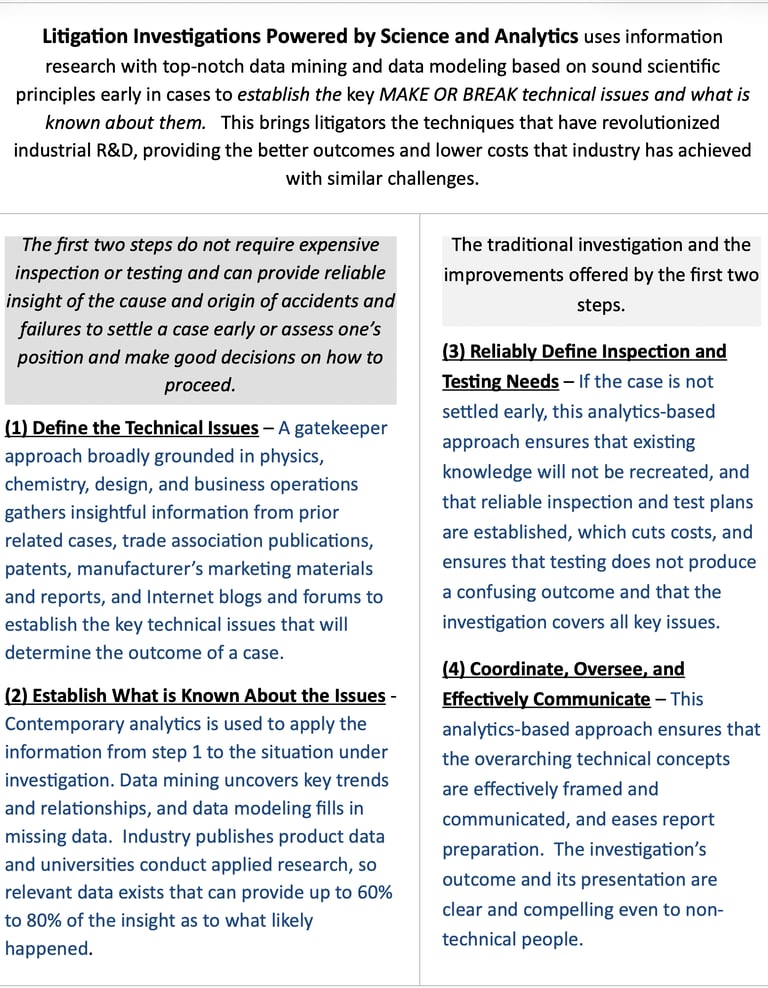
Dr. Fildes' analytics based on physical chemistry approach, summarized in the following figure, inherently implements the scientific method and is based on the scientific principles and methods used in the mainstream of scientific practice. Here is what you should expect....
Introduction
Scientists/engineers, and lawyers search for truth in different ways. Scientists and engineers follow the scientific method. Lawyers follow an adversarial process. Scientists and engineers have to be independent of the proceedings, unbiased, and objective. Lawyers are expected to be advocates. Scientists and engineers collect information about an issue, draw conclusions, and verify the conclusions. Lawyers know the desired outcome at the outset and advance arguments to support that outcome with the expectation that the arguments by both sides will illuminate the truth.
The litigation process is also not ideal for conducting scientific and engineering studies and much is outside of an expert’s control. Working through legal issues at the outset of a case can prevent experts from becoming involved as early as would be helpful. Lawyers conduct the discovery process and may or may not involve the experts. The available data may be sparse. Inspections are limited in number, time, and planning, and often conducted under the constraints of being in one of the litigant’s facilities. Budgets and time are limited. Depositions can be more about a preconceived narrative than about probing an expert’s methods and opinions. Judges make decisions about the admissibility of an expert’s work product. Legal teams frame the case to juries. Juries make the determination about the outcome of the case.
Nonetheless, experts play an essential role if not a controlling one. A scientific/engineering investigation that brings clarity will enable the parties to make good decisions about how to pursue the case, and when and how to seek final resolution. A scientific/engineering expert will also help a jury understand the cause and origin of a failure or accident (but not the legal issues) if a case goes to trial. To achieve this, a scientific/engineering expert should utilize the practices and procedures normally employed in the mainstream of their discipline (the scientific method for scientists and engineers) and utilize principles and methods that are scientifically sound (as demonstrated by common usage, publication, etc.). An expert should also be relatable, straightforward, and honest, and they should conduct the investigation in a way that provides insight and conveys that insight in a manner that is understandable and compelling.
Investigation Approach and Outlook
Scientific and engineering training do not typically prepare scientists and engineers to work in an adversarial environment where uncertainty will be exploited by the other side, the work product will be challenged by whatever means possible, and where the results have to be understood by people with potentially no technical background and possibly a lack of trust in science and engineering.
Like all aspects of life, science and engineering do not produce outcomes that are 100% certain, and scientific and engineering training discourage the presentation of results as certain. Nonetheless, judges and juries as well as litigants have to make black and white decisions to pursue a case or to award a verdict to one side of the other. Unlike academia, a litigation environment requires forming specific opinions in which the expert has high confidence because of the completeness and soundness of the investigation scope and methods. An expert’s investigation is as much about developing confidence in their opinions/conclusions as it is about initially developing those opinions/conclusions.
Scope of Work
The scope of work is critically important and will bound the range of what the testimony can cover. Initially, the scope will usually be to gather the relevant information and identify the key technical issues. Other expectations for the scope may be to provide a basis for evaluating a party’s position and what it will take and cost to prevail, and ultimately to establish a sound basis for forming and defending opinions as to the cause and origin of an accident or failure.
Investigation Process
In the Supreme Court Daubert decision Justice Blackmun emphasized that science is a process in which an inference or assertion must be derived by the scientific method, which he described as a validation technique. This means a technical investigation should gather insight from inspections, fact witnesses, expert reports, literature searches and analyses, and testing and analyses. This data-driven approach provides a natural validation process.
The information that comes from all of these sources needs to be compiled and woven together to provide an understandable and compelling result. A good expert is both a gatekeeper and a domain expert. Gatekeepers see the forest. Domain experts see the individual trees. A good expert will utilize the domain expertise provided by published studies of other experts to complement their expertise. A good expert will also communicate the work and results in a way that is confident, clear, and understandable to people regardless of their education. Words used in a technical context can have different or narrower meaning than they have in common usage, and a good expert will make this clear throughout their communications and testimony.
Results
The results of the investigation determine what can and cannot be said in testimony. Scientifically sound is a guiding principle of what can be testified to. Scientifically sound results and opinions come from a properly defined scope of work, objective assessment, and utilization of the scientific method.
Outcome
The outcome of the investigation is determined by the scope of work, the results, and the effective communication of these elements of the investigation. A client’s desired outcome is not a factor in determining the outcome of scientifically sound investigations. The best outcome an expert can provide is one that is objective, scientifically sound, and that provides clarity and actionable information upon which good decisions can be made, and compelling testimony can be provided.
Bio for John Fildes, Ph.D.
Dr. Fildes is a doctoral scientist who has conceived, organized, and conducted $28 million of projects including R&D, litigation expert investigations, and collaborations involving Government labs, large defense companies, and leading universities.
Dr. Fildes was also CEO of an $18 million professional scientific/engineering consulting firm; president of a not-for-profit R&D institute; founder and leader of a $6 million scientific/engineering consulting firm; leader of a $3.5 million startup product design firm; leader of a $10 million contract research lab at Northwestern University; a senior professional in the $4.5 billion Borg-Warner Corporation Research Center.
Product Failures Expertise
Friction; Abrasive Wear, Adhesive Wear, Testing, Friction Measurement, Wear Prevention, Lubricants, Oil Quality Monitoring, Solid Lubricants, Hard Protective Coatings, Decorative Coatings, Paint, Electroplated Coatings, Corrosion, Electrochemical Corrosion Measurement, Ice Prevention; Gas Sensors, Carbon Monoxide Detectors; Product Design Procedures.
Materials & Process Expertise
Composites for Aviation, Buildings and Civil Construction: Thermoset and Thermoplastic Resins and Adhesives, Resin Transfer Molding, Autoclaving, Impedance Spectroscopy; Use of Composite Materials and Spray Foams Made On-Site In Construction; Roadway Chip Sealing, Water Treatment; Intelligent Process Control.
Chemistry & Chem Processes Expertise
Prediction Of Materials Properties, Stability, And Compatibility; Chemical Exposure; Chemical Process Equipment Failures.
Contact us
Whether you have a request, a query, or want to work with us, use the form below to get in touch with our team.